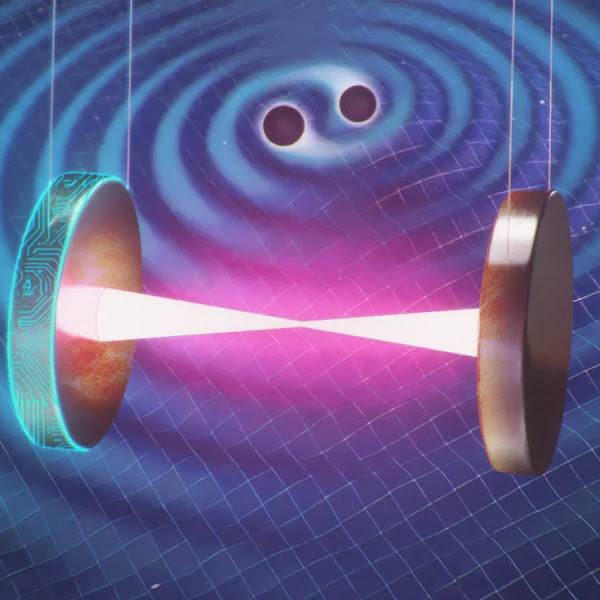
In a groundbreaking development, researchers have introduced Deep Loop Shaping, an AI-powered method that dramatically enhances the precision of gravitational wave observatories like LIGO. This innovation promises to unlock deeper insights into cosmic events such as black hole mergers and neutron star collisions, advancing our understanding of the universe’s fundamental dynamics.

Gravitational waves—tiny ripples in spacetime—are generated by some of the most energetic processes in the cosmos. Detecting them requires instruments of extraordinary sensitivity, yet even minute vibrations can disrupt measurements. Deep Loop Shaping tackles this challenge head-on by reducing noise in feedback control systems by 30 to 100 times, stabilizing critical components like interferometer mirrors and enabling clearer observations of distant astrophysical phenomena.
Developed in collaboration with LIGO and the Gran Sasso Science Institute, the method has been successfully tested at the Livingston observatory in Louisiana. By applying reinforcement learning with frequency domain rewards, the AI controller learns to suppress “control noise” without introducing harmful vibrations, achieving stability below the level of quantum fluctuations in some cases.

LIGO’s lasers reflect between mirrors positioned 4 kilometers apart, housed in the world’s largest vacuum chambers. The observatory measures length differences as small as 1/10,000 the size of a proton, necessitating near-perfect isolation from environmental disturbances. Deep Loop Shaping ensures that these ultra-sensitive measurements remain uncompromised, potentially allowing astronomers to detect hundreds more cosmic events annually.
Since its first detection of gravitational waves in 2015, LIGO has revolutionized astrophysics, confirming predictions of Einstein’s theory of relativity and revealing new insights into black holes and heavy element formation. However, intermediate-mass black holes—key to understanding galaxy evolution—remain poorly observed due to instrumental limitations. This new AI method expands LIGO’s reach, bringing these elusive objects into clearer view.

As Professor Rana Adhikari of Caltech notes, “Studying the universe using gravity instead of light is like listening instead of looking. This work allows us to tune in to the bass.” Deep Loop Shaping not only improves current observatories but also influences the design of future ground-based and space-based detectors. Its applications extend beyond astrophysics to vibration suppression in aerospace, robotics, and structural engineering, showcasing the transformative potential of AI in tackling complex dynamic systems.

Experimental results confirm that Deep Loop Shaping maintains system stability over prolonged periods, with hardware performance matching simulations. The method has eliminated the most unstable feedback loop as a significant noise source for the first time, marking a milestone in control system engineering.

By pushing the boundaries of observational capabilities, Deep Loop Shaping paves the way for discovering missing links in our cosmic knowledge. It exemplifies how interdisciplinary collaboration and AI innovation can illuminate the deepest mysteries of the universe, from its formation to the behavior of its most enigmatic objects.