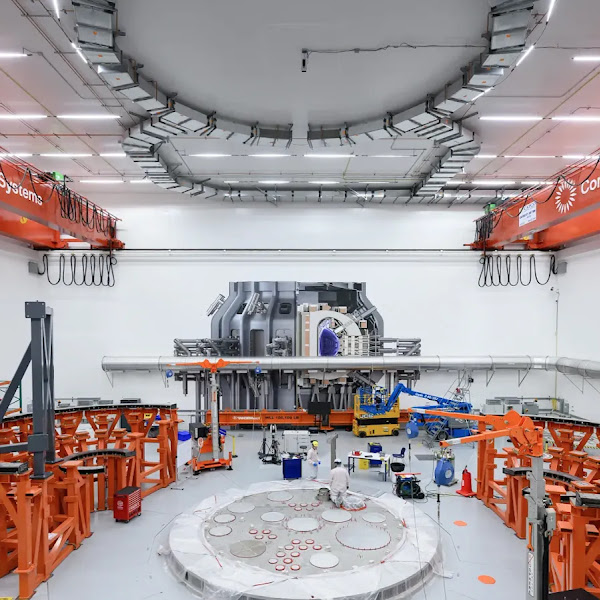
We’re excited to share groundbreaking developments in the fusion energy sector, where artificial intelligence is revolutionizing how we approach one of humanity’s greatest energy challenges. Through a strategic partnership between Google DeepMind and Commonwealth Fusion Systems (CFS), we’re witnessing the convergence of cutting-edge AI technology with advanced fusion hardware to accelerate the timeline toward clean, limitless energy.

Fusion energy, the process that powers our sun, represents the holy grail of clean energy—promising abundant power without long-lived radioactive waste. The challenge lies in maintaining plasma stability at temperatures exceeding 100 million degrees Celsius within the confines of a fusion machine. This incredibly complex physics problem is now being tackled through sophisticated AI systems.
CFS is pioneering this accelerated path to commercial fusion energy through their innovative SPARC tokamak, which leverages powerful high-temperature superconducting magnets. SPARC aims to become the first magnetic fusion machine in history to achieve net energy gain—producing more power from fusion than required to sustain the reaction. This breakthrough, known as crossing “breakeven,” represents a critical milestone toward viable fusion energy.
The collaboration builds upon previous breakthroughs where deep reinforcement learning successfully controlled plasma configurations in tokamaks. The development of TORAX—an open-source plasma simulator written in JAX—has been particularly transformative, enabling researchers to simulate plasma behavior across both CPUs and GPUs while seamlessly integrating AI-powered models.
The partnership focuses on three key areas: creating fast, accurate plasma simulations; identifying optimal paths to maximize fusion energy; and developing novel real-time control strategies using reinforcement learning. TORAX has become indispensable in CFS’s daily workflows, allowing teams to run millions of virtual experiments before SPARC even becomes operational, saving precious time and resources while providing flexibility to adapt plans as new data emerges.

Operating a tokamak involves countless configuration choices—from magnetic coil currents to fuel injection and heating power. Manual optimization would be incredibly inefficient. Through TORAX combined with reinforcement learning and evolutionary search approaches like AlphaEvolve, AI agents can explore vast numbers of operating scenarios, rapidly identifying the most efficient paths to net energy generation. This enables CFS to focus on the most promising strategies from day one, even before SPARC reaches full operational capacity.
The collaboration extends to developing AI systems for real-time plasma control, particularly crucial for managing the immense heat generated during full-power operation. Reinforcement learning agents are learning to dynamically control plasma to distribute heat effectively across plasma-facing materials, potentially developing adaptive strategies more sophisticated than anything human engineers could design.

Looking beyond immediate SPARC optimization, the vision extends to establishing AI as the intelligent, adaptive core of future fusion power plants. Google’s investment in CFS underscores the commitment to moving this revolutionary technology toward commercialization. By uniting the transformative potential of AI with fusion energy, we’re building the foundation for a cleaner, more sustainable energy future that could fundamentally reshape our global energy landscape.
This represents just the beginning of an extraordinary journey toward making fusion energy a practical reality. As Devon Battaglia, Senior Manager of Physics Operations at CFS, notes: “TORAX is a professional, open-source plasma simulator that saved us countless hours in setting up and running our simulation environments for SPARC.” The fusion research community continues to validate and calibrate these AI systems against historical tokamak data, ensuring accuracy and adaptability as SPARC begins operations.